Most workplaces need training in several emergency topics: fire response, evacuation, work at height and first aid. Each topic has its own regulations, courses and drills. Planning them together helps avoid gaps and makes better use of training time. This article outlines a framework for an annual emergency training plan that includes VR training.
Start With Legal Requirements
In Indonesia, several regulations relate to these topics:
- Fire: Minister of Manpower Regulation No. PER.04/MEN/1980 on portable fire extinguishers, and Minister of Manpower Decree No. KEP.186/MEN/1999 on fire response units, which includes fire drills.
- Work at height: Minister of Manpower Regulation No. 9 of 2016 on Occupational Safety and Health in Work at Height.
- First aid: Minister of Manpower and Transmigration Regulation No. PER.15/MEN/VIII/2008 on first aid in the workplace.
The plan should first list the training, drills and certifications these regulations require for the organisation.
Identify Who Needs What
Different groups need different training:
- All employees: evacuation procedures, alarm response and basic fire extinguisher use.
- Fire wardens and response teams: their specific duties under the fire response unit structure.
- Workers at height: fall protection, equipment inspection and rescue procedures.
- First aid officers: certified first aid courses and refresher practice.
- New employees and contractors: induction covering all relevant topics.
Mapping roles to topics shows how many people need each type of training.
It also helps to note turnover. Roles such as wardens and first aid officers need to be refilled when people leave or change positions, and new appointees need training before they take on the role.
Assign the Right Method to Each Need
Each training method has a different purpose:
- Certified courses provide required qualifications and hands-on skills.
- Drills test the building, systems and organisation as a whole.
- Hands-on practice builds physical skills, such as fitting a harness or applying a bandage.
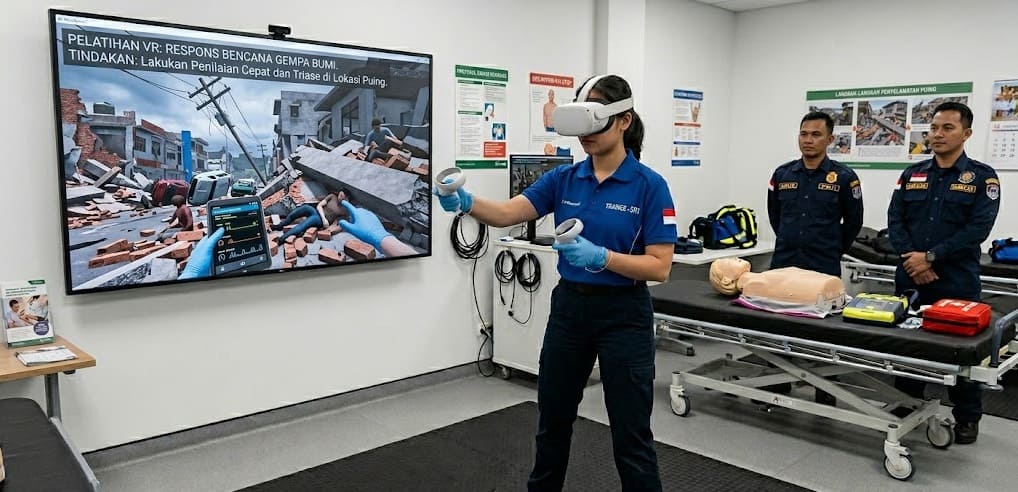
- VR training provides repeated practice of decisions and procedures in realistic scenarios.
VGLANT lists fire evacuation and response, work at height and first aid among its VR safety modules, along with heavy machine operation, hazard spotting, hot work and confined space.
A Sample Annual Structure
The following is an example. Each organisation should adjust it to its regulations, risks and schedule.
Quarter 1
- Induction for new staff, including VR evacuation and fire extinguisher scenarios
- Review of last year’s training data
Quarter 2
- Fire drill for the whole site
- VR refresher for wardens, focusing on issues found in the drill
- VR work at height sessions before planned maintenance work
Quarter 3
- Certified first aid refresher courses for P3K officers
- VR first aid scenarios for P3K officers between courses
Quarter 4
- Second fire drill
- VR sessions for any staff who have not completed training
- Review of annual results and planning for the next year
Use Data to Adjust the Plan
VGLANT’s platform records metrics such as task duration, reaction time and actions taken. Its four-step process includes deploying and tracking training, then analysing results to improve readiness and expand training.
Data from VR sessions can show:
- which employees have not completed training
- which decisions are often made incorrectly
- which sites or departments need more practice
Drill reports and incident records can be reviewed alongside VR data to decide where to focus. Near-miss reports are also useful, because they show which situations occur in practice.
Logistics
VGLANT offers ready-to-use products in a portable VR case, which can be moved between sites. Its bespoke services convert existing SOPs into VR scenarios. When planning, consider:
- the number of headsets available
- session length and the number of people per session
- space required for VR sessions
- staff to run sessions and support first-time users
Limits
VR training supports, but does not replace, legally required drills, certified courses and hands-on practice. It is one part of a complete emergency training plan.
Summary
An annual emergency training plan that combines certified courses, drills, hands-on practice and VR training can cover fire, evacuation, work at height and first aid more consistently. Organisations interested in adding VR to their training plan can contact VGLANT to discuss their requirements.sponse and gives supervisors a record of each attempt. Organisations interested in VR first aid training can contact VGLANT to discuss their requirements.