The pistol is the standard sidearm for many police officers. Pistol qualification is commonly carried out on a firing range, where officers fire at fixed targets from set distances within a time limit. This format measures accuracy and weapon handling.
Situations in which officers may need to use a firearm also involve other skills: recognising a threat, deciding whether to draw, giving commands, moving to cover and deciding whether to fire. These decision-making skills are not assessed by fixed-target qualification.
KOMINA, the virtual training platform developed by Komando Imersif Indonesia, supports scenario-based pistol training. This article explains the relevant features.
Limits of Range-Only Training
Range qualification remains necessary. It confirms that an officer can operate the weapon safely and hit a target. However, a fixed target does not require the officer to assess a situation or choose between options.
Range time is also limited by factors such as ammunition budgets, range availability and the number of instructors. Scenario-based training in VR can provide additional practice between qualifications.
KOMINA’s Pistol Props
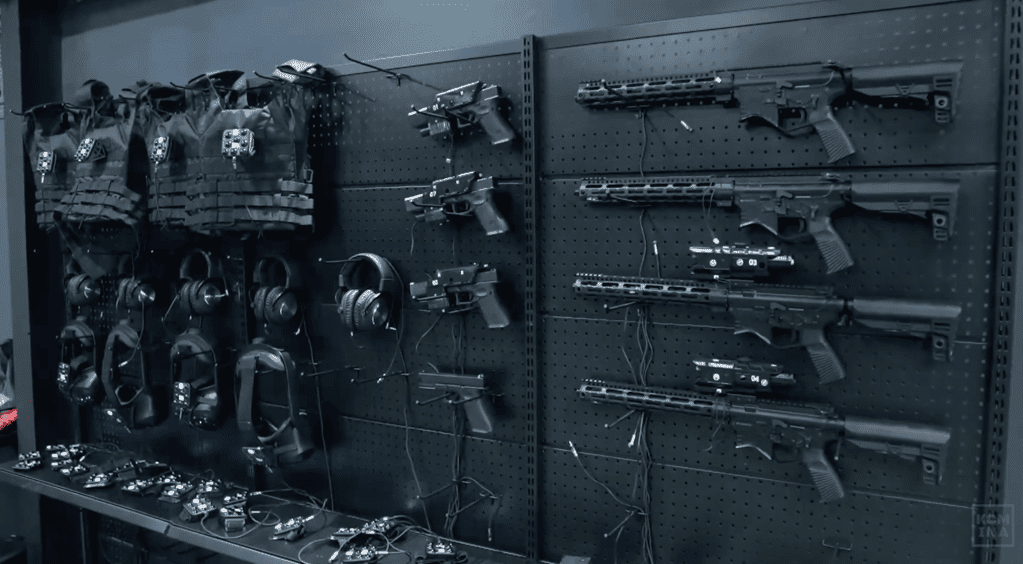
KOMINA’s armory describes its pistols and sidearms as precision handguns with realistic trigger pull and slide action. Listed features include:
- Haptic feedback
- Accurate sight alignment
- Tactical holster integration
The props are based on modified airsoft platforms. KOMINA states that pneumatic systems are used to simulate recoil.
Holster integration means the prop can be carried in a holster during scenarios. Each scenario can therefore begin with the weapon holstered, so the draw becomes part of the exercise.
KOMINA’s website describes its Weapon Proficiency use case as advanced firearms training with accurate ballistics, recoil simulation and marksmanship assessment.
Technical Specifications
KOMINA’s technology page lists 4K resolution per eye, a 120Hz refresh rate, latency below 5ms and tracking precision of 1mm. Its full-body tracking covers head and eye tracking, upper and lower body movement, hand and finger tracking, posture analysis and gesture recognition. The armory also lists tactical gloves with full finger tracking and haptic feedback. These are KOMINA’s published specifications.
Scenario-Based Practice
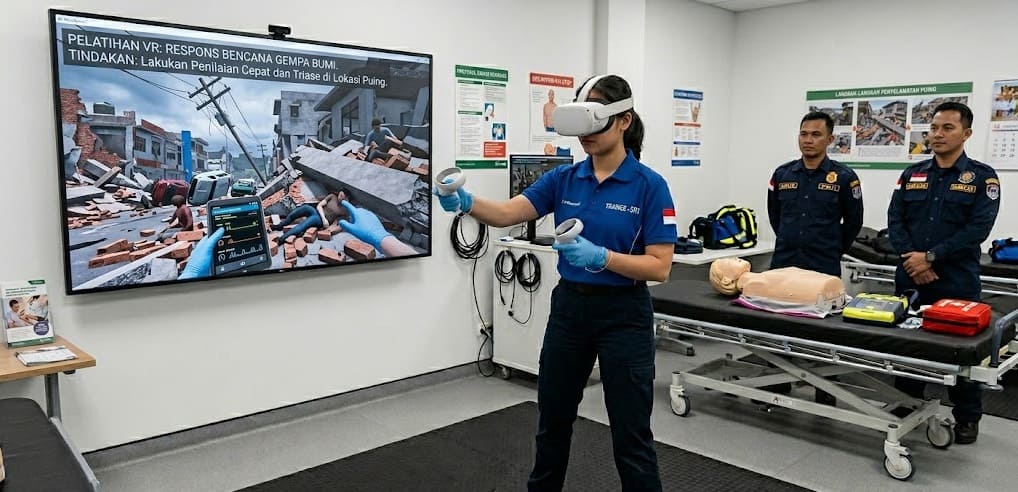
In KOMINA, trainees move physically through a free-roam VR environment. Full-body motion capture records their position, posture and movement, and KOMINA’s tracking includes hand and finger tracking.
Instructors use the map editor to create environments relevant to police work, such as residential buildings, shops, streets or office corridors. The NPC spawner places AI agents:
- Civilians: panicked, compliant or unpredictable
- Hostiles: aggressive, defensive or ambush
- Law enforcement units: supportive, coordinated or independent
This allows scenarios in which the officer must decide whether to keep the weapon holstered, draw and cover, or fire. Pre-built scenarios that can be used for this purpose include Building Clearance, Drug Raid Operations and Crowd Control.
Instructor Views
Instructors can follow a session from three perspectives: a top-down view of the whole arena, a cone view showing a trainee’s perspective and field of view, and a free roam view for inspecting the environment.
After-Action Metrics
KOMINA’s after-action review records the full session. Metrics relevant to pistol training include:
- Shot accuracy and grouping
- Reaction time
- Decision-making speed
- Threat identification time
- Movement patterns and tactical positioning
- Heart rate and stress level
The 3D replay can be viewed from any angle, including the trainee’s own perspective. This allows instructors and officers to review each decision during the debrief.
Progress tracking stores individual results across sessions. Instructors can use these records to identify which skills, such as draw speed, threat identification or accuracy while moving, need more practice.
Physical Feedback
KOMINA uses electric shockbelt haptics for hit confirmation, with adjustable intensity. This gives trainees immediate feedback when they are hit during a scenario, for example when they do not move to cover.
Relationship to Live-Fire Training
KOMINA states that virtual training complements traditional training rather than replacing it. Officers still need live-fire practice and qualification with their service weapon to maintain familiarity with its recoil and noise and to meet their organisation’s standards.
VR scenario training adds practice in drawing, moving and decision-making, with measured feedback on both decisions and accuracy. For training units with limited range time, it provides a way to maintain sidearm skills between qualifications. Organisations can contact KOMINA to request a demonstration of pistol scenarios.