
One of the most frustrating sights in occupational safety is the freeze response. We see it constantly: workers who are fully certified and have passed every K3 written test stand paralyzed as a fire spreads or a colleague collapses. They know the PASS method. They can recite CPR steps. But they don’t move. They watch, they wait for a supervisor, or they simply evacuate, leaving the emergency to escalate.
In post-incident interviews, the story is always the same: “I knew what to do, but I couldn’t make myself move.” This is the Hesitation Gap. It is a psychological failure point that traditional classroom training is fundamentally incapable of fixing.
Declarative Knowledge vs. Procedural Readiness
The problem lies in how we teach. Most safety training builds declarative knowledge—the ability to describe a procedure. But an emergency requires procedural readiness—the instinctual capacity to execute that procedure under extreme stress.
Knowledge alone doesn’t trigger action; confidence does. Specifically, the confidence that you can perform correctly while your heart is racing and smoke is filling the room. This isn’t built by watching a PowerPoint. It is built through successful, repeated experience in environments that feel real. If you’ve never “failed” safely, you’ll be too afraid to “try” when the stakes are live.
The Unfamiliarity Amplifier
Environmental shock is a massive driver of the freeze response. If your only experience with a fire extinguisher (APAR) was a sunny afternoon in an empty parking lot, a real office fire will be a sensory overload. The roar of the fire, the blinding smoke, and the heat are all “unfamiliarity amplifiers” that jam the brain’s decision-making center.
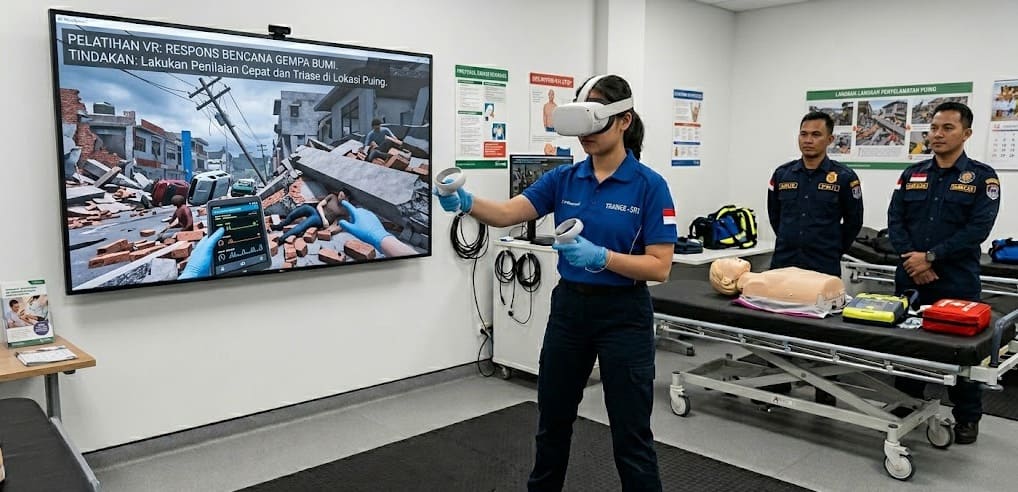
VGLANT’s VR architecture closes this gap. As VGLANT notes, the immersion makes people feel as if they are truly there. By simulating dynamic flames and spatial alarm audio, the trainee’s nervous system acclimates. When a real crisis hits, it isn’t “new” to the brain—the worker has already been there, virtually, and they know they can survive it.
Accumulating Small Wins
VGLANT builds a confidence reservoir. In VR, a trainee doesn’t just “learn” about fire; they suppress one. Then they suppress a larger one. Then they manage a compound scenario where they have to triage a casualty while controlling a blaze.
Each successful session is a “small win” that hardwires the identity of a First Responder. This is the core of the VGLANT philosophy: Zero Risk, Tracked Results. With unlimited repetition, a worker can achieve 50 successful “saves” in VR. By the time they face a real fire, the procedural reflex is so deep that it overrides the instinct to freeze.
Quantifying Confidence: The Data Edge
The VGLANT Tracked Data Records provide a metric most safety managers ignore: Response Initiation Time.
- Traditional Training: Only tracks if you can eventually do the task.
- VGLANT: Tracks how many milliseconds it took you to start moving after the fire appeared.
If a worker’s initiation time is high, they are a “freeze risk,” regardless of how well they know the theory. This allows HSE managers to intervene with targeted training before a real tragedy occurs.
Breaking the “Deference” Habit
In Indonesian industrial culture, hierarchy often compounds the freeze response. Junior staff may instinctively wait for a mandor or supervisor to give the “go-ahead” during a crisis. In a fire, those 30 seconds of waiting are the difference between a small flare-up and a total loss.
VGLANT’s Single-Responder Architecture forces autonomy. There is no supervisor in the headset. No one is coming to help. The trainee has to make the call alone. This conditioning is vital for remote sites—like mining concessions in Kalimantan or factories in Riau—where help might be an hour away. It transforms a worker from a “certified spectator” into a self-reliant first responder.
The Verdict: Training for the Adrenaline Spike
VGLANT isn’t just about fire extinguishers or first aid kits; it’s about the human impact. It moves safety training from the classroom to the “live” digital crucible. By addressing the psychological roots of hesitation, VGLANT ensures that when the alarm sounds, your workforce doesn’t just know what to do—they actually do it.