
Ask any experienced firearms instructor what separates good training from great training, and the answer is almost always the same: fidelity.
Not just knowing the steps. Not just running through the procedure in your head. Actually feeling the weight of the weapon. Feeling the recoil. Developing muscle memory that activates under pressure without having to think about it.
For decades, building that level of fidelity in training required live ammunition, real ranges, and significant expense. KOMINA, the virtual training platform purpose-built for military and law enforcement professionals, approaches this problem from a different angle — and the hardware they’ve built to solve it is genuinely impressive.
Why Cheap VR Gear Doesn’t Cut It for Defense Training
Before we dig into what KOMINA offers, it’s worth being direct about something.
Not all VR training is created equal. There’s a category of virtual training for military and law enforcement that uses consumer-grade headsets, basic motion controllers, and environments that look more like a video game than a real-world scenario. That category has its place — basic familiarization, classroom supplements — but it doesn’t build the muscle memory and stress response that genuine operational readiness requires.
The physics has to be right. The weight has to be right. The feedback has to be real enough that the trainee’s nervous system treats the experience as authentic.
KOMINA was engineered specifically for this requirement.
The Weapons: Replicas That Train, Not Just Simulate
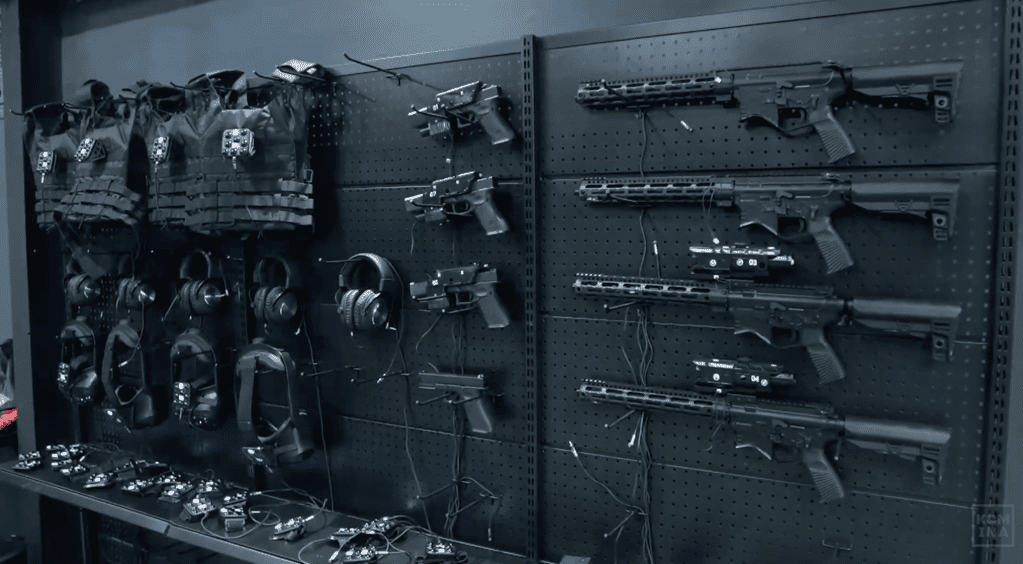
KOMINA’s weapon replicas are designed to match the real thing in weight, balance, and mechanics. This isn’t cosmetic accuracy — it’s functional accuracy.
The assault rifle replicas feature authentic weight distribution that matches standard-issue service weapons. The reload mechanics require the same physical motion as a real magazine exchange. The fire mode selector is functional. The pneumatic recoil system produces a kick that the shooter’s body actually has to manage — not a rumble in a controller, but a genuine recoil pattern.
Pistols and sidearms include accurate trigger pull weight and slide action. Haptic feedback fires on trigger engagement. Sight alignment is precise and consistent with real-world iron sight geometry.
Tactical equipment — grenades, flashbangs — has weight-accurate replicas with working pin-pull mechanisms. The system calculates realistic blast radius and programs the appropriate trainee response.
These details compound. After enough repetitions with gear this accurate, the muscle memory a soldier builds in KOMINA’s virtual environment transfers to real-world handling in ways that conventional simulation simply doesn’t produce.
The Wearables: When Your Body Is Part of the Simulation
The weapons are only part of the picture. What makes virtual training for military and law enforcement truly effective — or not — is whether the trainee’s body is actually in the loop.
KOMINA’s haptic vest changes this equation completely.
The vest contains over 40 impact zones, each capable of delivering targeted physical feedback when the trainee takes a hit. The intensity is adjustable and the system is safety-certified, but make no mistake — when the vest fires, you know it. The feedback is sharp enough to trigger genuine stress response. Real adrenaline. Real elevated heart rate.
Combined with biometric sensors monitoring heart rate and stress in real time, KOMINA can track not just what a trainee did — but how their physiology responded to pressure. This data feeds directly into after-action analysis.
The tactical gloves close the loop on weapon handling. Full finger tracking means every grip adjustment, every trigger finger placement, every reload motion is captured and analyzed. Haptic feedback in the glove fingers provides additional tactile sensation during weapon interaction.
The headset itself delivers 4K resolution per eye at 120Hz, with 3D spatial audio. The visual and acoustic environment is rendered at a level that, for the majority of trainees, crosses the threshold of suspension of disbelief that genuine stress response requires.
The Electric Feedback System: Training Consequence Without Training Casualties
There’s a concept in military training psychology called “consequence learning” — the idea that humans adapt most effectively when their actions carry tangible results, positive or negative.
In live combat training, consequence is obvious and sometimes severe. In traditional simulation, there essentially is none. You get hit, the screen says “casualty,” you restart.
KOMINA’s Electric Shock Penalty system occupies the middle ground. Controlled electrical stimulation — safety-certified, adjustable in intensity — fires when a trainee is struck. It’s not painful in any serious sense. But it is real. It registers in the nervous system as a genuine consequence. And it produces genuine adrenaline.
That adrenaline is the training. The ability to make clear tactical decisions while physiologically stressed is precisely the skill that separates effective operators from those who freeze or make errors under pressure. You can only build it by practicing under actual stress.
Building What Transfers
The goal of all this hardware — the pneumatic rifles, the haptic vests, the electric feedback system — isn’t novelty. It’s transfer.
Training transfer is the measure of how much improvement in a simulated environment actually shows up in real-world performance. High-fidelity simulation transfers well. Low-fidelity simulation transfers poorly.
KOMINA’s investment in physical accuracy exists precisely to maximize this transfer. Every detail that makes the virtual experience more physically authentic increases the likelihood that what a trainee learns stays with them when they’re outside the simulation and the situation is real.
That’s the only metric that ultimately matters in defense training.
Explore KOMINA’s full hardware specifications and training platform at https://komina.co/